929x800 |
640x551 |
120x103 |
75x75
 Mike Sibley
Comment
Posted Sep.18th, 2017, viewed 33 times
Mike Sibley
Comment
Posted Sep.18th, 2017, viewed 33 times
EXERCISE 1
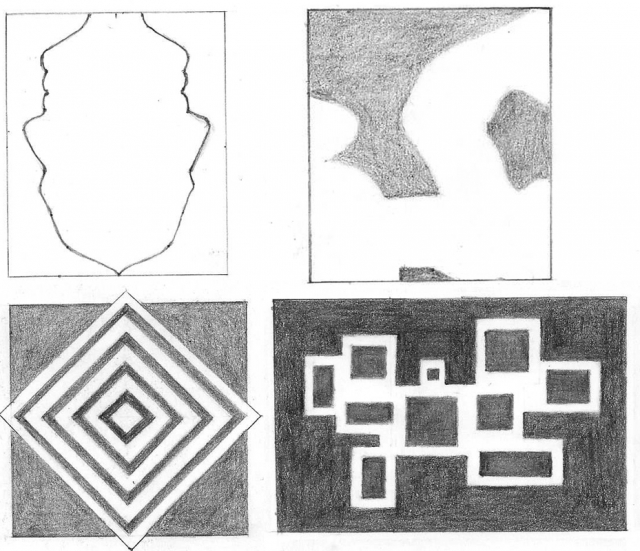
Very good, Melodee. By studying and copying the space between the lines and border, you were simply drawing abstract negative space. I cannot stress the importance of this technique too much.
I remember once spending a day or two trying to get the correct curve of a dog's bottom eyelid. It was only when I resorted to looking at the surrounding negative space, and drawing that, that I realised my brain was telling me the curve was convex (it was what my brain expected to see) where in reality it was concave. Once I saw it for what it really was, I couldn't believe I could have seen it any other way :o) It can take time to train yourself to see negative space in everything but, once you've achieved the ability to switch between positive shape and negative space, you'll find it invaluable.
EXERCISE 2
I don't mind how you worked this, or its accuracy. All I'm looking for is that it was constructed using only negative space. As far as I can see, this is looking excellent with no signs of errors. However... what you completed wasn't the exercise, only the example :o)
If you have time to complete it, you'll learn more from doing the actual exercise :o)
It's a logical "left brain" thing that loves to name things. "That's a MOUTH!" It is, but it's the stored generic mouth - not the mouth in your reference.
Also, the icons we store are all hard-edged. Soft shapes - shapes with no defined borders - don't feature in this system. That's probably why children draw eyes and mouths but not noses - or if they do draw them, they only draw the nostrils.
The best way to defeat the detection/naming problem is to study and draw the negative space around the nameable feature. The negative space is abstract and cannot be recognised as being "something". Whenever I have a problem correctly visualising something, I look at the negative spaces around it. It has solved countless problems over the years.
EXERCISE 3
Not quite what I had in mind but - hey, they're looking OK! :o) All I'm looking for here is evidence of the detection and rendering of negative space, and these are looking excellent! Not of course recognisable (as expected) because they're inorganic geometric shapes, but you definitely have a developed an eye for negative space. In my opinion that's one of the most powerful tools available to any artist.
I'm looking forward to your op-art handfork :o)
In response to comment:
Community Critique
This work has not yet received a critique from members of the Drawspace community. Check back soon!