1252x745 |
640x381 |
120x71 |
75x75
 Mike Sibley
Comment
Posted Mar.15th, 2019, viewed 29 times
Mike Sibley
Comment
Posted Mar.15th, 2019, viewed 29 times
<< I have found the last two exercises very difficult as I have trouble visualising the 2D image in 3D. I manage for a short time (seconds) then its gone again. The leaves, I have had umpteen goes at, but my brain struggles to stay focused on one leaf it keeps saying "what's that leaf over there doing" while I'm drawing a different shadow!!! >>
I suspect you might find this much easier when you design your own leaves. You could, for example, work on one leaf, then a second, and establish the shadows before you proceed further. In any case, I think you'll generally find seeing in three-dimensions easier with practice.
On the whole, there's far more correct than not in your image.
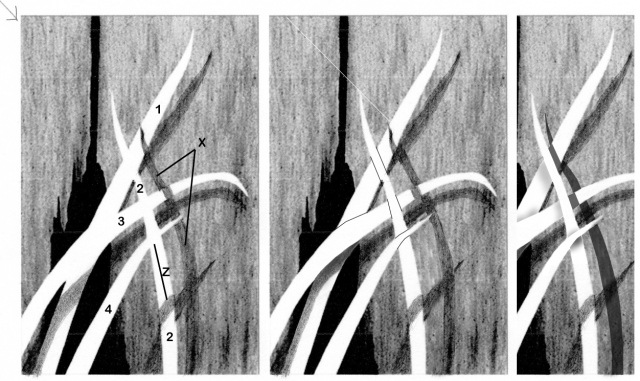
According to your shadows, from back to front, they are:
Leaf 1 right at the back, Leaf 3, Leaf 2, and Leaf 4.
Leaf 1 is casting its shadow on the wood, and the shadow tells me it's almost touching the wood. Then its top is curving away from the wood - towards us. The shadow is the correct length too.
Leaf 2 is casting its shadow on Leaf 1, Leaf 3, and the wood. You've correctly offset the shadow where it crosses the two leaves. However, the shadow on the wall (at X) has shifted the wrong way. Your light is at the top left, so all shadows will be cast below and right. Also, the further the shadow has to travel, the further it will be away from the leaf that's casting it. 2 casts shadows on 1 and 3, and the wood is further away than those two leaves, so the shadow has further to travel. I'll cover this next but I also think this shadow is too far away from leaf 2.
Leaf 3 is casting its shadow on Leaf 1 and the wood. The shadow is continuous throughout its length. That suggests Leaf 1 is pressed against the wood, which it might be, as its own shadow suggests that. However, I think the shadow is far too low. Its position would only occur if it was some distance in front of Leaf 1. Instead, consider it almost touching Leaf 1 as it crosses it (see my alteration). Now you can use the shadow to expose the edge of Leaf 3. And a hint of shadow on the other side exposes that edge - without having to use any outline. The same applies to Leaf 2's shadow. If you had moved it alongside the leaf, it would have perfectly described that leaf's edge. We'd know immediately that 2 was in front of both 1 and 3 (see right-hand addition).
The shadow cast by Leaf 4 on Leaf 2 is perfect! ...ish :o) Your offset is correct, but ... well, this sums up the main problem. Your shadows are being cast very far away from the leaves that are casting them. For example, distance Z... why so far? To cast a shadow in that position, Leaf 4 would have to be very far in front of Leaf 2. But if you snuggle them up together, you can create the shadows alongside (or even partially tucked under) the leaf casting it - as I've done at the right. The enormous advantage is that it instantly allows your eye to follow the leaf's edge and know with absolute certainty that one is front of another.
Try this, if you haven't seen it before: DIVE TO CONTROL. There's an animation about 7 minutes in that might help you.
In response to comment:
Community Critique
This work has not yet received a critique from members of the Drawspace community. Check back soon!