1137x587 |
640x330 |
120x62 |
75x75
 Mike Sibley
Comment
Posted Feb.3rd, 2020, viewed 110 times
Mike Sibley
Comment
Posted Feb.3rd, 2020, viewed 110 times
EXERCISE 4
Each of these exercises builds on knowledge learned from the previous one. If, as I just suggested, you had created the midground in Exercise #3 by just drawing them around imaginary leaves instead of outlining them, you would have found this exercise much easier. It works quite well, but it lacks depth due to pale, and missing, darks. However, your leaves begin and end, and I can follow any one throughout its length. A common error is creating leaves that start low down and then just peter out, so I can't follow them, or they disappear behind a foreground leaf and then fail to reappear.
The next time you're outdoors take a long look at a clump of grass. I think you'll be surprised how dark the holes are. There is very little, or no, light filtering down into that clump.
The main intention with these exercises was to give you the freedom to simply create in the midground and background. Because the foreground is "designed" and outlined it almost doesn't matter what you draw behind them. The foreground alone will give the "this is grass" message. It's how we see grass in real life, or any foliage - the foreground foliage tells us what it is. We accept that everything behind it is a part of the same plant. And we don't expect to understand anything in the midground or background. In fact, it's that lack of understanding that adds the realism.
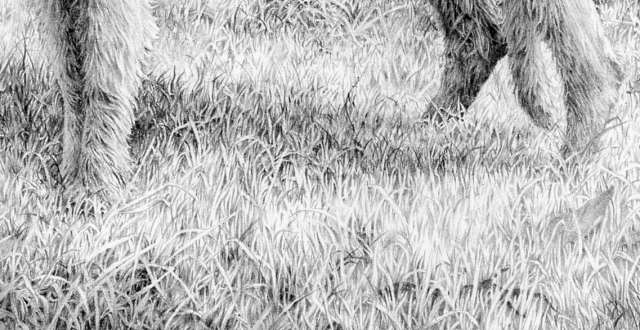
I've attached an enlarged section of one of my drawings. I began at the bottom edge and worked upwards. At the base I will have outlined a few of the foreground leaves - I call them "status" leaves because they are designed to catch the eye and say "grass". In between them I began with tiny dark triangles, the edges of which suggested where leaves occurred - like the "street map" exercise (2). As with exercise 2, each "leaf" has to go somewhere, so adjacent shading takes that into account and allows that leaf to grow in length. Again like Exercise 2, I later decide which leaf is in front of another. By "later" I might mean minutes later or just a few seconds - whenever the reality of the situation makes sense to me.
Other status leaves further up were created as I worked and appear wherever I felt I'd naturally see a bit of foreground.
This is a very free and enjoyable way of working. I was about to say it could be extended to the drawing of hair... but in fact this grass method began as a hair technique.
If you follow a reference and outline the distinctive foreground hairs - or your interpretation of them - then you can draw spontaneously behind those status hairs. All the client, or anyone else, will see is the foreground hairs.
Many years ago I used to take my reference photos with a Canon AE1 with a 200mm zoom lens and a motor drive. That drive could take two photos a second. It was looking through those photos that made me realise how much changes second by second... so why the heck was I trying to faithfully copy every hair in one reference photo? My drawing became much looser and more descriptive from that point onward.
If you look at the legs of the Irish Wolfhound in the grass - you won't find those hairs in the reference. My hair follows the correct direction of growth; it will contain features seen in the references (such as the way the hair parts at the knees); it contains the essence of what I see in the references; but it's my free interpretation.
And the grass and hair share the exact same techniques.
Finally, as I've mentioned before, take a long look at grass - and then hair. Soak up as much information as you can. How deep can you look before you are no longer able to see complete leaves? Notice how quickly it becomes dark in the depths. And how very dark the holes through to the deepest shade are. Then ask yourself "Why do I KNOW this is grass?"
I'll cover Exercise 5 as a reply to this one.
In response to comment:
Community Critique
This work has not yet received a critique from members of the Drawspace community. Check back soon!