1574x800 |
640x325 |
120x61 |
75x75
 Mike Sibley
Comment
Posted Feb.17th, 2021, viewed 11 times
Mike Sibley
Comment
Posted Feb.17th, 2021, viewed 11 times
EXERCISE 2
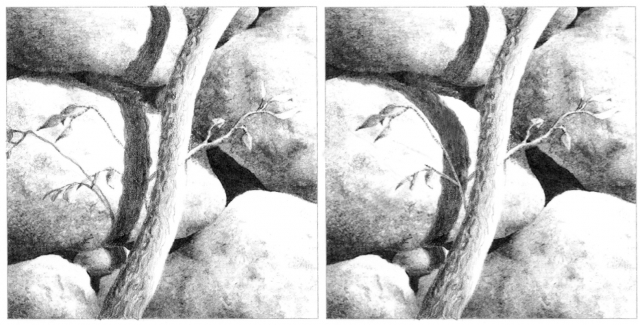
Some people find this harder than it looks. Not only does the angle of the tree come into play when positioning the shadow, but the shape of the rocks as well. You've done very well.
It does force you to have to think three-dimensionally, which was one of its intentions. Anyone looking at your drawing would understand it instantly. From that point of view, it's a success.
However, it could be improved. The overriding impression I get is that you think the shadow has to connect from rock to rock. That's not true. In my alteration, I've decided that the top of the middle rock is further away from us than the top rock, which overhangs above it.
The further away the object casting the shadow is from the surface on which it's casting the shadow - the further the shadow has to travel. So, in this case, the top of my shadow travels far to the left. It doesn't connect to the shadow cast across the top rock, because that rock is closer to us.
Two quick observations: The value of your shadow is not strictly correct. It meets the shadows cast by the rocks, and your tree's shadow is darker. There is only one light source, so all cast shadows should be the same value. Also, your shading of the shadows is linear and the lines are quite visible. That doesn't look realistic because you should have used a rock-texture shading technique. The shadow is not a "thing" it's rock receiving partial light.
I think, to some extent, you ran into the "we look but don't see" problem. We instinctively understand shadows. They tell us how one object relates to another, or the surface that it's on. It tells us a lot about the three-dimensional form and texture of the surface the shadow falls on. We know what the lighting was like - overcast with soft edges, or strong sun with sharp edges; the time of day - how high the sun was in the sky - and possibly the season; and so on...
The problem is that we don't consciously look at them. Personally, I think the actual position of the shadow is not of paramount importance, but the way it clings to the rocks is. As I explained, shadows are extremely useful tools because they relay so much information - in this case, the overall type of light (overcast, sunny etc); provide depth by visually pushing the tree forwards; tell the viewer that the tree is upright or leaning back or forwards; and they describe the rocks in three-dimensions. You can literally sculpt the rocks as you draw the shadow across them. All that from a single shadow.
Also, the human mind is perfectly capable of filling in the blanks. And including too many shadows usually just causes confusion. Did you notice that the shadow of the branch is missing in my version? :o)
If you ever take the Advanced course we spend a week on the science of shadows, so it really is quite a complex subject. And given its complexity, I think you did very well with this.
In response to comment:
Community Critique
This work has not yet received a critique from members of the Drawspace community. Check back soon!