1482x700 |
640x302 |
120x57 |
75x75
 Mike Sibley
Comment
Posted Jan.28th, 2020, viewed 104 times
Mike Sibley
Comment
Posted Jan.28th, 2020, viewed 104 times
EXERCISE 2
I'm wondering if you tried to work on too large an area? When you break this down and apply it to only one small manageable area, it's quite straightforward and simple. Also, a little exaggeration goes a long way. You need to show me, the viewer of your work, exactly what you intended to convey. Here, your shadows don't immediately tell me that one layer is on top of another, and the locks of hair in the lower layer don't appear to be emerging from beneath the layer above.
It's actually close to being a decent result. My intention was to help you to better understand the process by using a larger-than-life scale for this exercise. So don't expect realism to emerge :o)
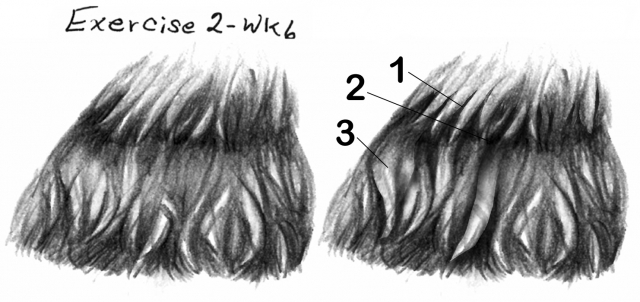
Let's say you have the first (top) layer established, Now you have to imagine that the ends of those hairs are casting a shadow, and that all the hairs you draw below it are emerging from that shade.
When you are shading in black to create the ends of the first row of hairs, do try to make the blacks solid. This is working quite well, but when the lower row emerge from the shadows, I don't completely get the impression that they are growing from underneath the first layer. That's because the shadow doesn't darken as it reaches back underneath the overlying hairs (1). Imagine those top locks are casting their shadows on the ones below, and are removing much of the light. Then (2) use that shadow to interact with the lock or locks it's falling on.
I like the way you've divided up the locks so the ends don't form any sort of pattern. But the highlighted areas don't belong to anything that extends back under the top layer. Just work on one lock at a time and sculpt it to show the viewer exactly what it's doing. In my case (3) it divides along the way and one half dives under the other.
I've had a quick play with part of your drawing to show you what I mean. I've also tried to make more sense out of some of the locks. Think about them three-dimensionally as you work. Ask yourself "If hair 'A' is beneath the hair crossing it, surely it should be in its shade?" Or "If hair 'B' is emerging from beneath another lock of hair, shouldn't it emerge from its shadow?" And to help you concentrate on each one, ONLY draw hair 'A' or 'B' - treat it a drawing in its own right. That might seem to take a long time, but it's actually much quicker than completing a bigger area and then having to return to make it "look right". When it comes to larger locks, do the same - treat lock 'C' as a single drawing. Work on it until it's completed along its entire length and then move on.
In response to comment:
Community Critique
This work has not yet received a critique from members of the Drawspace community. Check back soon!